NL
NL ES
ES PL
PL TR
TR


Suppose you enter a ‘private property’ and are bitten by the dog. Perhaps you may have wanted to greet the new neighbors. Or you had to deliver a package to the address in question. Can you hold the dog owner liable for your personal injury? Or is the dog bite your own fault? Our lawyers will explain it to you using some examples.
Strict liability for dog owner
A dog bite can give you a real physical, mental and financial blow. For example, suppose you sustain a serious bite wound on your arm. Then you may:
- Need to relearn how to use your arm
- Get unsightly scars from the biting incident
- Need therapeutic sessions to get rid of your anxiety symptoms
- Incur high medical expenses
- Lose income because you are temporarily unable to work
Therefore, you want to find out if you are entitled to damage compensation. Let’s start at the beginning. Article 6:179 of the Dutch Civil Code states:
“The owner of an animal is liable for the damage caused by the animal, unless liability under the previous section would have been absent if he had had control over the behavior of the animal that caused the damage.”
The dog owner is therefore liable for the injury caused by the dog. This concerns damage that the dog causes out of its own energy. Keeping animals comes with strict liability. Because animals can react unpredictably, this involves risk. When purchasing an animal, you agree to this strict liability.
The unless clause
Suppose you are bitten because the dog was ordered to go towards you. Then we speak of an unlawful act, Article 6:162 of the Dutch Civil Code. In that case, you are of course also entitled to damage compensation. However, this reasoning is not always valid. We will clarify this with an example.
Suppose you are at work. While you are at work, there is a burglary. The burglar is attacked by your dog and sustains injuries. In that case, you cannot be held liable. If you had controlled the dog, the same might have happened. Because if you had been home, you might have sent the dog after the burglar in self-defense. So in that situation, the dog would not have bitten out of its own energy. However, this is not considered a wrongful act. After all, you would have acted out of emergency.
What rules apply on private property?
So the dog owner is primarily liable for the bite wounds. But do these rules also apply on private property? That depends on the situation. Several situations can arise. The dog owner’s property is:
- Freely accessible.
- Enclosed with a gate that can be opened from the outside. But there is a warning sign.
- Enclosed with a gate that is secured with a lock. In addition, there is an intercom and a warning sign.
1: the property is freely accessible
Suppose you want to greet the new neighbors. The property is not fenced off and there are no warning signs. You walk into private property and are grabbed by your legs by a dog.
In this situation, your neighbors can be held liable for the injury. After all, the property is not fenced off and there are no warning signs. Passersby can therefore not know that danger is imminent. In addition, a property that is not closed is freely accessible according to Article 5:22 of the Dutch Civil Code:
“When a property is not closed off, anyone may enter it, unless the owner may experience damage or hindrance from this or has clearly indicated that it is prohibited to be in the property without his permission, without prejudice to that which is determined with regard to public roads.”
2: the property is partially enclosed
Suppose you deliver packages with a delivery van. You walk towards a private property and see that there is a fence around it. There is a sign on the fence that reads: ‘Beware! Guard dog on duty’. However, there is no intercom and there is no letterbox at the gate. You see that the gate can be opened from the outside and take your chances. As you enter the private property, you are bitten in the arm by the dog.
In this situation, too, the owner is liable for the injury. After all, there was no letterbox and no intercom. So how else could the package have been delivered? Yet, you are also partially at fault. After all, you ignored the sign and opened the gate. But since you were doing your job, the percentage of own fault will not be high. After all, the owner should have just made sure the dog could not have gotten to you, or that you could not have gotten to the dog.
3: the property is completely enclosed
Suppose you are collecting money for charity. You approach a property that is fenced off and has a gate, warning signs, and an intercom. The signs bear one of the following texts:
- NO TRESPASSING Art. 461. of Penal Code
- Enter at your own risk
- Beware of the dog
You try the intercom first, but no one responds. When you check the gate you will see that there is a lock around it. You still try to enter the property. Once you enter, you are bitten in the leg by the dog.
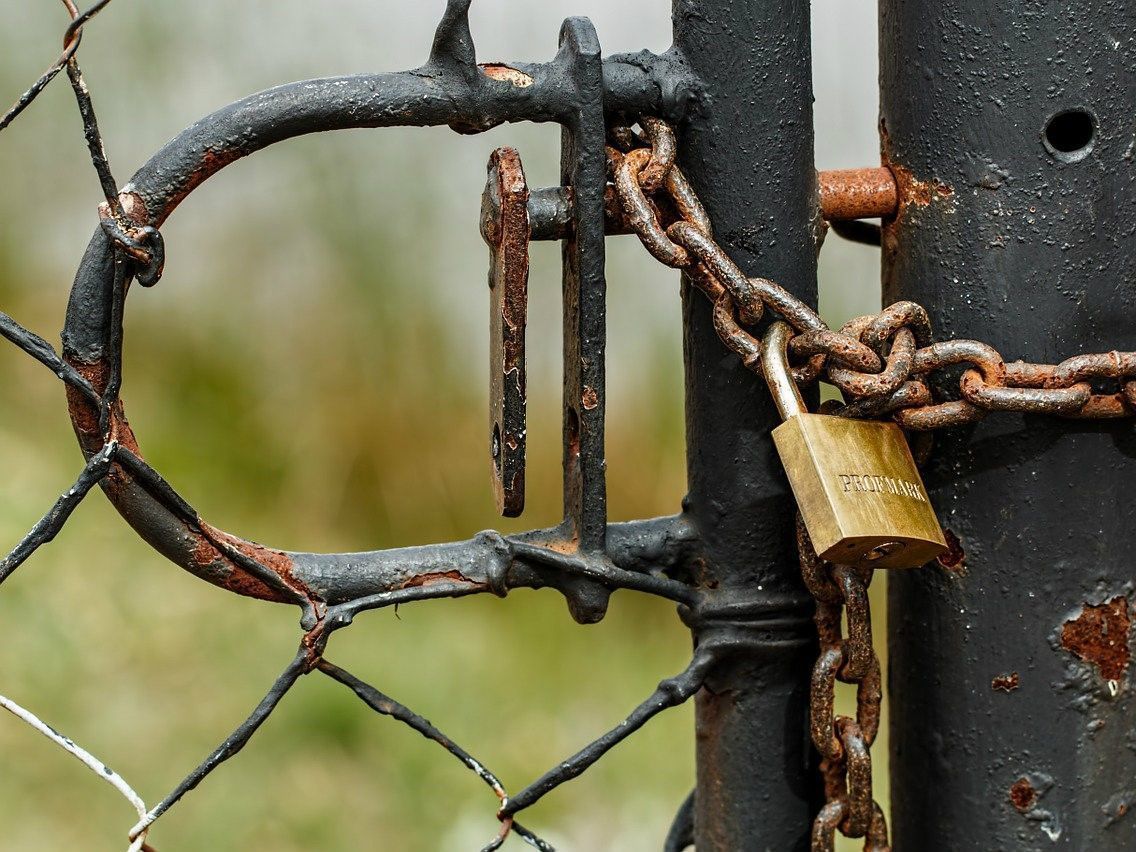
In this situation, the owner is not liable for the injury. After all, the owner has taken all precautions. The gate is locked, there are clearly visible warning signs and an intercom. It is therefore obvious that you are not allowed to enter the private property.
Warning signs must be clearly visible
In some cases, however, the warning signs are not valid because:
- The signs are not clearly visible
- The signs are not present at all possible entrances
- You have to deliver a package or post, but there is no mailbox in front of the gate or an intercom
Tip: always get legal assistance
Have you been bitten by a dog on private property? Always engage an experienced lawyer to claim compensation. These complex dog bite cases can lead to tricky liability discussions. This can put you under a lot of stress. Moreover, you often do not know what you are entitled to. Therefore, it is better for you to focus on recovering from your injury. While an expert lawyer claims the compensation you are entitled to.

Want to share this article?