


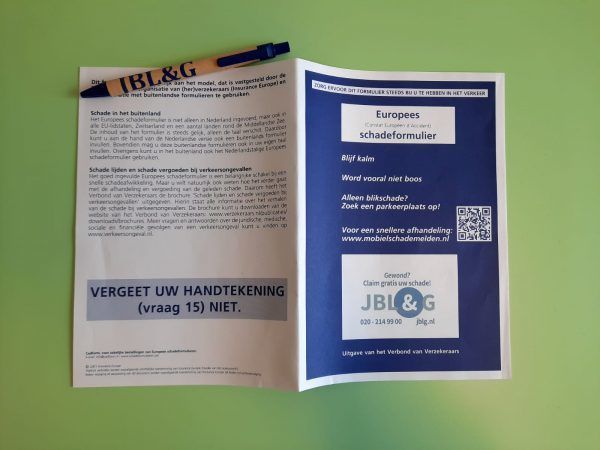
After a collision, it is important to complete the claim form. Have you suffered any injuries? If so, state this on the claim form, no matter how minor the injury is. In this article, we outline what to look for when filling out the claim form. Read our 20 tips. You can also print out this list.

Index
Tip 1: Always complete the claim form, even if there appears to be no damage;
Tip 2: Find a safe and quiet place;
Tip 3: Try to fill in the claim form at the scene;
Tip 4: Fill in the front of the claim form as completely as possible;
Tip 5: Write down the name and address of the culprit;
Tip 6: Enter the correct insurance details and registration number of the counterparty;
Tip 7: Write down the names and addresses of the witnesses;
Tip 8: Indicate any injury;
Tip 9: Indicate the other material damage;
Tip 10: Make a situation sketch;
Tip 11: Make a test drawing;
Tip 12: State the circumstances;
Tip 13: Create clarity;
Tip 14: Sign the claim form;
Tip 15: Do not sign in case of disagreement about the facts;
Tip 16: Take a picture of the completed form;
Tip 17: Fill in the back of the form at home;
Tip 18: Complete all questions;
Tip 19: Also use the claim form in the event of a collision abroad;
Tip 20: Ask for help if you are having trouble.
Fill in the claim form as soon as possible
After a collision, it is best to complete the claim form as soon as possible. This way, you avoid any disagreements afterward about the damage and how it was caused. Moreover, your damage compensation is often settled faster with a correctly completed claim form.
20 tips for correctly completing the claim form
Below is an overview of our 20 tips. Are you injured or do you have any complaints? Then tick the box. Check out our traffic accident page for free legal assistance in the event of personal injury.
Tip 1: Always complete the claim form, even if at first glance there appears to be no damage. Once home, it often turns out that there is damage after all. It is also possible that you will later develop physical complaints as a result of the collision. It is important that you then have the correct details of the other party and that the circumstances of the collision are recorded.
Tip 2: Find a safe and quiet place to fill out the claim form, then you can best concentrate on the questions.
Tip 3: Try to fill in the claim form at the scene. You can also include photos of the collision.
Tip 4: Fill in the front of the form as completely as possible and make sure that the text is clearly legible. This way, you avoid any disagreements afterward about the damage and how it was caused.
Tip 5: Write down the name and address of the culprit. If the other party is at fault for the collision, you are entitled to free legal assistance. This is also the case when injuries are involved.
Tip 6: Make sure you write down the insurance details and the registration number of the counterparty correctly.
Tip 7: Write down the names and addresses of the witnesses. Even if they are fellow passengers or family members. They can help you hold the other party liable.
Tip 8: Indicate any injuries. If there is an injury, please indicate this in question 3 (injured parties). The injury does not have to be serious. Headaches or a stiff neck are also injuries and can indicate whiplash. Often the real complaints only arise after a few days.
Are you injured? See our page Compensation for personal injury for information on how to claim damage compensation. If you need us to resolve your case, you can fill in the contact form. Tell us about the collision and your personal injury. One of our lawyers will call you back the same day during working hours.
Tip 9: Indicate the other material damage. In addition to your car and that of the other party, is another car or a post or fence along the road damaged? If so, note this in question 4 (other material damage).
Tip 10: Make a situation sketch. Indicate with an arrow the direction in which the cars were driving and on which side they first hit each other.
Tip 11: Make a test drawing. For the situation sketch, first make a test drawing and only then draw on the form.
Tip 12: State the circumstances. For question 12 (circumstances) indicate by ticking the boxes how the collision happened. For example, did you stop at a traffic light, or were you driving? Fill in the total number of ticked boxes under each column. This prevents the counterparty from ticking an extra box after signing.
Tip 13: Create clarity. Complete question 14 to clarify the situation.
Tip 14: Sign. Make sure that both you and the counterparty sign the front of the form. Do not be the first to sign the form. Wait until your counterparty has also signed. Under no circumstances give your completed version to the other party without keeping a copy signed by the other party yourself.
Tip 15: Do not sign if there is a disagreement about the facts. If you do not agree with the ticked boxes in question 12, do not sign.
Tip 16: If you do not have a copy of the form yourself, take a photo of the completed form with your smartphone.
Tip 17: Fill in the back of the form at home. Only complete the front of the form at the scene of the accident. You can fill in the back at home.
Tip 18: Complete all questions. You may notice when you fill in the back of the claim form that you have already answered some questions on the front. Nevertheless, it is important for your compensation to fill it in again.
Were you injured in the collision? You will receive free assistance in claiming compensation. We will handle the discussion with the third-party insurance company on your behalf!
Tip 19: In the event of a collision abroad, you fill in the same claim form in Europe. Make sure you understand what the counterparty has filled in before signing. This prevents the other person from wrongfully blaming you for the collision.
Tip 20: Ask for help if you are having trouble. Call 020 215 9210 if you have any questions about the claim form. Our legal advisors will be happy to help you complete and claim your personal injury damages.
Important when completing the claim form
Always complete the claim form, even if at first glance there appears to be no damage. Write down the names and addresses of the witnesses. They can help you hold the counterparty liable. Always indicate if there is any injury, regardless of how minor. Then you can more easily recover any personal injury damage from the counterparty.

Want to share this article?