NL
NL ES
ES PL
PL



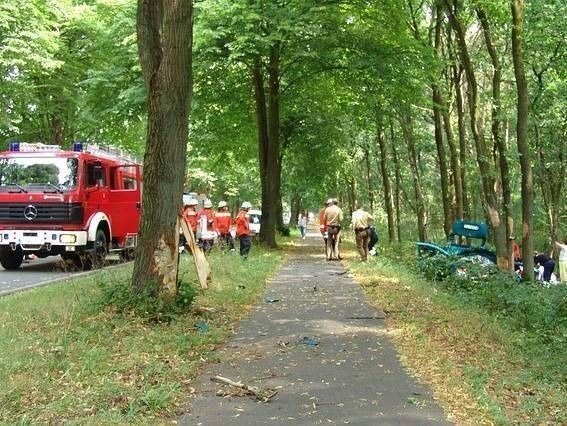
Do you always know exactly who has right of way, if the slightly elevated road you are driving on leads to another road? You are probably dealing with an exit construction, which requires you to give way to everyone you cross, including pedestrians. Sometimes that can be completely unclear, or people simply do not know the rules. Actor Aart Staartjes lost his life in an accident last winter while he drove his microcar out of an exit onto the road and a car with priority was unable to avoid him. Every personal injury agency has clients who have become victims of unclear priority situations around exits. The Dutch Automobile Association (ANWB) has been arguing for shark’s teeth road markings for many years, but in vain. JBL&G takes stock of the situation.
Even in a busy city, taking and receiving right of way usually goes reasonably organically and fluidly, but not always. Places where things are bound to go wrong are the many dozens of exit constructions that have been built everywhere in recent decades. Anyone who comes out of such an exit must give way to everyone, but people are generally far from familiar with this; many people are dangerously not aware of the right of way rules on such an exit, and for foreigners, it is even more difficult to make sense of it.
Many people will not even know what an exit construction actually is, even though they come across it every day. And that is nothing to scoff at: according to traffic rules in the Netherlands, everyone who leaves an exit must give way to all crossing traffic, even pedestrians. As a cyclist or motorist, you are a ‘guest’ on the footpath on such an exit construction. The problem in many cities is that one moment a cyclist is protected by such a construction, while the next moment he has to hit the brakes to give everyone right of way.
Criteria for exit constructions
An exit is characterized by its destination or its construction. With a visibly limited destination, such as the exit of a garage, a farm, or a gas station, it is often immediately obvious that it is an exit. However, there are also plenty of busy shopping streets, arterial roads, and bicycle intersections that casually lead to equally busy intersections, squares, and other streets with an exit construction. There, the construction of the exit must make it immediately clear to everyone who has the right of way and who does not, but this often proves difficult.
An exit construction has:
- An elevated, continuous sidewalk along the main road, possibly also a continuous cycle path
- Sloped entrance blocks on both sides of the exit
- No curbs
If these criteria are met, road users can be expected to recognize the exit construction as such and to behave accordingly, the law states. The reality, however, is more unruly: exits come in hundreds of variants and disguises. On the website of the ANWB and other traffic clubs, people still regularly ask about and discuss the status of an exit. Virtually all personal injury firms have clients who have been the victim of an unclear exit construction, accidents happen almost every week around an exit, and even judges have also regularly examined collisions and conflicts related to exits for decades. Last winter, actor Aart Staartjes was killed in an accident after he came out of an exit with his microcar and was hit by a car that had right of way.
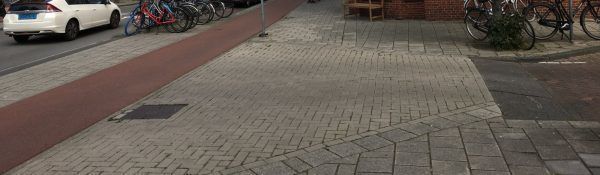
“Exit construction in Amsterdam: Sloped entrance blocks: check. Continuous cycle path: check. Continuous sidewalk, unfortunately not: Here, paving bricks were used while these should have been sidewalk tiles.”
ANWB: shark’s teeth markings!
As early as 2007, the ANWB strongly advocated the installation of shark’s teeth on all exit constructions, in order to eliminate any ambiguity about the right-of-way rules. The association propagated this after having conducted research on 1800 Dutch citizens. Eight in ten of them were unsure about giving way when pulling out of an exit. Shark’s teeth would remove that doubt. The ANWB determined that municipalities are apparently unsuccessful in constructing exits in such a way that there can be no ambiguity about the priority rules. There are, however, guidelines* for the installation of exit construction, but they do not include shark’s teeth. It must be noted that pedestrians would not be protected by shark’s teeth, but neither are they on half-hearted exit constructions. The ANWB: “Putting shark’s teeth is cheap and improves clarity. That would be our choice.” In 2012, the union repeated its call for shark’s teeth at every exit, but also added priority signs. Legally, only one additional sentence would have to be included in the relevant piece of legislation to be able to provide shark’s teeth and priority signs.
In 2020, only more exit constructions have been introduced, sometimes at dangerous intersections. For example, sometimes the busiest streets lead to equally busy squares with merely a simple exit construction. Another street leading onto that square might as well be equipped with double rows of shark’s teeth, priority signs, and guide lines, because the uniformity is always far from desired. Thus, there are many points where right of way and exit constructions cause tricky situations, but putting shark’s teeth—that’s taking matters too far.
Right of way must be clear at a glance
JBL&G spoke with ANWB traffic expert Stefan Westerman: “Since our call in 2007 for shark’s teeth at every exit, there have been some shifts. We must continue to use our common sense: you would want every road to be directly clear to everyone at a glance, that no traffic signs or anything else is needed. But if you have to: an exit construction always has a number of fixed components, and if one of these is missing or is executed incorrectly, it immediately becomes an ordinary intersection again. This is what you see in many situations. For example, instances where paving bricks have been used where there should have been sidewalk tiles. Right of way is far too important to let it depend on things like this. If, as a cyclist, you think you know for sure that you have right of way and are a bit bold, this can end very badly if the right of way is not arranged as you thought.”
“Often they only find out during the execution of the work, when the road worker is already busy, that for example a certain element of the exit construction just no longer fits well there or something, and then they just adjust it or do something else. However, we think that right of way is far too important to ignore. Right of way must be immediately clear everywhere. An exit construction must always comply with the guidelines, and if that cannot be realized with the construction of the exit, as you often see in practice, then shark’s teeth and priority signs should be considered.”
“Foreigners must also have a hard time with our exit constructions; I can imagine that a lot of tourists here have no idea what to make of it, who and what to give priority, and when. But if you go abroad yourself, you also read up on the different traffic rules first, right? And once you have arrived in that country, you naturally have a good look at how the locals themselves are doing there. But I wouldn’t recommend that in the case of tourists on bicycles in Amsterdam: please don’t imitate a savvy, seasoned Amsterdam cyclist, because from time to time he or she also cycles through a red light, over the sidewalk, and against the direction of travel. So let them not use that as an example! But it would make sense to draw the attention of tourists to this, even if only with a leaflet on the handlebars of their rental bikes.”
Like almost all other offices, personal injury firm JBL&G has various clients who have been hit while the other party was coming out of an exit construction and should therefore have given way. “Sometimes our lawyer has to look three times before they fully understand the traffic situation in such an accident,” says JBL&G owner Steffy Roos du Maine. “And then it often really depends on the type of paving bricks whether something is considered an exit or not. Of course, you should be able to immediately see at a glance what it is and who has right of way, as the ANWB wholeheartedly agrees. If that is not the case, please just install shark’s teeth. It is relatively cheap, it is clear to everyone, and it is just as safe! Some find it confusing and unnecessary – shark’s teeth in addition to an exit construction – but I feel a thousand times better protected by clear shark’s teeth on the road than by an almost invisible bump in the road of a few centimeters high with an unclear status.”

17 million experts
Frans Heijnis, project manager of traffic and transport of CROW, the body that issues all guidelines for the infrastructure, was co-author of the Guidelines on speed bumps, plateaus, and exits: “We, of course, do not have a monopoly on wisdom, but this is a topic that supposedly everyone knows everything about, with 17 million experts. With an exit construction, the road manager does not necessarily want to regulate the right of way: he simply wants to make the hierarchy in the road network clear. Anyone who leaves an exit as a motorist performs what is called a ‘special maneuver’, legally speaking, in which you must give way to all crossing traffic, including pedestrians. It may well be that this knowledge has faded a bit for many people. They may assume that if you come from the right, you almost automatically always have the right of way. But that does not apply if you come out of an exit. It would be useful to refresh that knowledge about exiting an exit.”
“But it can also be the case that an exit is simply not recognized as such by many people. Then the road manager has clearly made a mistake and something has to be done about it. Look, the fact that people are doubting whether or not they have the right of way is sometimes exactly what is desired: then they might drive a little slower and don’t just storm across a street. But exit constructions should be so clearly recognizable everywhere that they are unambiguous, and they should be applied uniformly everywhere. After all, that is precisely the strength of traffic rules: that you can expect the same thing throughout the Netherlands.”
*CROW: Guideline speed bumps, platforms, and exits.

Want to share this article?